lib.EoS.virial module
Virial equation of state implementation
lib.EoS.virial.Virial: The main class with all integrated
functionality
- Second virial coefficient correlations:
- Third virial coefficient correlations:
lib.EoS.virial.C_Orbey_Vera()lib.EoS.virial.C_Liu_Xiang()
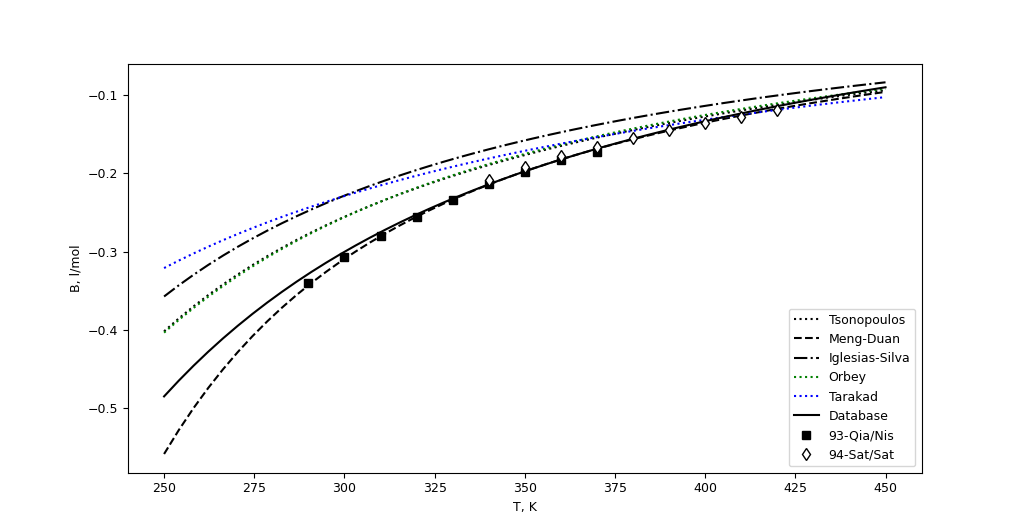
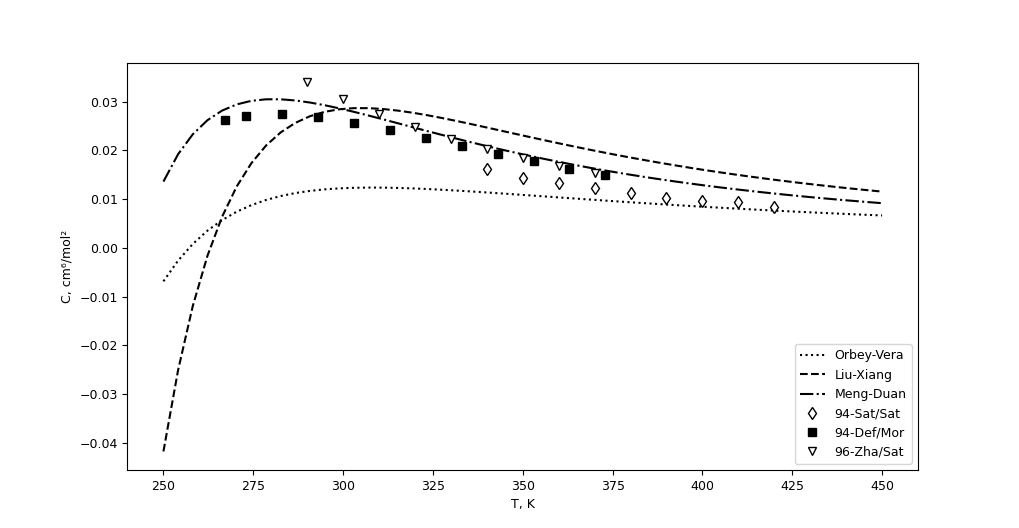
Example code of usage, plot the correlations for R32 and compare with some sources of experimental values
from matplotlib import pyplot
from numpy import linspace, r_

from lib.mEoS import R32
from lib.EoS import virial

D = R32.momentoDipolar.Debye
Vc = R32.M/R32.rhoc

# 2nd virial coefficient
B1 = []
B2 = []
B3 = []
B4 = []
B5 = []
B6 = []
coef = virial.B_Database[R32.id]

Ti = linspace(250, 450, 50)
for T in Ti:
    B1.append(virial.B_Tsonopoulos(T, R32.Tc, R32.Pc, R32.f_acent)[0])
    B2.append(virial.B_Meng(T, R32.Tc, R32.Pc, R32.f_acent, D)[0])
    B3.append(virial.B_IglesiasSilva(T, R32.Tc, R32.Pc, Vc, R32.f_acent, D)[0])
    B4.append(virial.B_Orbey(T, R32.Tc, R32.Pc, R32.f_acent, R32.id)[0])
    B5.append(virial.B_Tarakad(T, R32.Tc, R32.Pc, R32.id)[0])
    B6.append(virial._B_Database(T, coef)[0])
pyplot.plot(Ti, B1, label="Tsonopoulos", ls=":", c="k")
pyplot.plot(Ti, B2, label="Meng-Duan", ls="--", c="k")
pyplot.plot(Ti, B3, label="Iglesias-Silva", ls="-.", c="k")
pyplot.plot(Ti, B4, label="Orbey", ls=":", c="g")
pyplot.plot(Ti, B5, label="Tarakad", ls=":", c="b")
pyplot.plot(Ti, B6, label="Database", ls="-", c="k")

# Experimental date
# Qian, Z.Y., Nishimura, A., Sato, H., Watanabe, K.
# Compressibility Factors and Virial Coefficients of Difluoromethane
# (HFC-32) Determined by Burnett Method
# JSME Int. J. Ser. B. 36(4) (1993) 665-670
T = [290, 300, 310, 320, 330, 340, 350, 360, 370]
B = r_[-0.33975, -0.30666, -0.28011, -0.25594, -0.23379, -0.21422,
       -0.19777, -0.18327, -0.17231]
pyplot.plot(T, B, ls='', marker="s", mec="k", mfc="k", label="93-Qia/Nis")

# Sato, T., Sato, H., Watanabe, K.
# PVT Property Measurements for Difluromethane
# J. Chem. Eng. Data 39(4) (1994) 851-854
T = [340, 350, 360, 370, 380, 390, 400, 410, 420]
B = r_[-207.9, -191.4, -178.2, -166.2, -155.2, -144.7, -135.6, -128.1,
       -119.5]*1e-3
pyplot.plot(T, B, ls='', marker="d", mec="k", mfc="w", label="94-Sat/Sat")

pyplot.ylabel("B, l/mol")
pyplot.xlabel("T, K")
pyplot.legend()
pyplot.show()
from matplotlib import pyplot
from numpy import linspace, r_
from scipy.constants import R

from lib.EoS import virial
from lib.mEoS import R32

Zc = R32.Pc/R32.rhoc/R*R32.M/R32.Tc/1000
D = R32.momentoDipolar.Debye

# 3rd Virial coefficient
C1 = []
C2 = []
C3 = []
Ti = linspace(250, 450, 50)
for T in Ti:
    C1.append(virial.C_OrbeyVera(T, R32.Tc, R32.Pc, R32.f_acent)[0]*1e6)
    C2.append(virial.C_LiuXiang(T, R32.Tc, R32.Pc, R32.f_acent, Zc)[0]*1e6)
    B = virial.B_Meng(T, R32.Tc, R32.Pc, R32.f_acent, D)
    C3.append(virial.C_Meng(T, R32.Tc, R32.Pc, D, B)[0]*1e6)

pyplot.plot(Ti, C1, ls=":", c="k", label="Orbey-Vera")
pyplot.plot(Ti, C2, ls="--", c="k", label="Liu-Xiang")
pyplot.plot(Ti, C3, ls="-.", c="k", label="Meng-Duan")

# Sato, T., Sato, H., Watanabe, K.
# PVT Property Measurements for Difluromethane
# J. Chem. Eng. Data 39(4) (1994) 851-854
T = [340, 350, 360, 370, 380, 390, 400, 410, 420]
C = r_[0.01625, 0.01431, 0.01325, 0.01226, 0.01133, 0.01034, 0.009646, 0.009418, 0.00848]
pyplot.plot(T, C, ls='', marker="d", mec="k", mfc="w", label="94-Sat/Sat")

# Defibaugh, D.R., Morrison, G., Weber, L.A.
# Thermodynamic Properties of Difluoromethane
# J. Chem. Eng. Data 39(2) (1994) 333-340
T = [267, 273, 283, 293, 303, 313, 323, 333, 343, 353, 363, 373]
C = r_[0.0263, 0.027, 0.0274, 0.0268, 0.0256, 0.0242, 0.0226, 0.0209, 0.0193, 0.0178, 0.0162, 0.0149]
pyplot.plot(T, C, ls='', marker="s", mec="k", mfc="k", label="94-Def/Mor")

# Zhang, H., Sato, H., Watanabe, K.
# Gas Phase PVT Properties for the Difluoromethane + Pentafluoroethane
# (R32+R125) System
# J. Chem. Eng. Data 41(6) (1996) 1401-1408
T = [290, 300, 310, 320, 330, 340, 350, 360, 370]
C = r_[0.0341, 0.0305, 0.0275, 0.0248, 0.0224, 0.0203, 0.0185, 0.0168, 0.0153]
pyplot.plot(T, C, ls='', marker="v", mec="k", mfc="w", label="96-Zha/Sat")

pyplot.ylabel("C, cm⁶/mol²")
pyplot.xlabel("T, K")
pyplot.legend()
pyplot.show()
Other correlations don’t implemented
Romero-Lielmezs (1989)
Correlation for second virial coefficient using the Redlich-Kwong cubic EoS. The correlation need the compound dependent coefficient x.
Romero, A., Lielmezs, J. Correlation of Second Virial Coefficient for Polar Fluids. Thermochimica Acta 145 (1989) 257-264, http://dx.doi.org/10.1016/0040-6031(89)85145-7.
Besher-Lielmezs (1992)
Correlation for third virial coefficient using the Peng-Robinson cubic EoS. The correlation need the compound dependent coefficient x.
Besher, E.M., Lielmezs, J. Correlation for the third virial coefficient for non-polar and polar compounds using a cubic equation of state. Thermochimica Acta 200 (1992) 1-13, http://dx.doi.org/10.1016/0040-6031(92)85101-z.
Chueh-Prausnitz (1967)
Correlation for third virial coefficient. The correlation need the compound dependent coefficient d, give in paper for few compound.
Chueh, P.L., Prausnitz, J.M. Third Virial Coefficients of Nonpolar Gases and Their Mixtures. AIChE J. 13(5) (1967) 896-902, http://dx.doi.org/10.1002/aic.690130516.
de Santis-Grande (1979)
Correlation for third virial coefficient. The correlation need two aditional molecular parameters as dipole polarizability and bondi molecular volume. The paper give these parameters for several compounds but not very much.
de Santis, R., Grande, B. An Equation for Predicting Third Virial Coeffcients of Nonpolar Gases. AIChE J. 25(6) (1979) 931-938, http://dx.doi.org/10.1002/aic.690250603.
- lib.EoS.virial._B_Database(T, args)[source]
Calculate second virial coefficient, its 1st and 2nd temperature derivarives from coefficient in database
- Parameters:
- Tfloat
Temperature, [K]
- argslist
Array with polinomial coefficient
- Returns:
- Bfloat
Second virial coefficient [dm³/mol]
- Btfloat
T(∂B/∂T) [dm³/molK]
- Bttfloat
T²(∂²B/∂T²) [dm³/molK²]
- lib.EoS.virial.B_Tsonopoulos(T, Tc, Pc, w, mu=None)[source]
Calculate the 2nd virial coefficient using the Tsonopoulos correlation
\[\frac{BP_c}{RT_c} = f^{(0)}+\omega f^{(1)}+f^{(2)}+f^{(3)}\]\[f^{(0)} = 0.1445 - \frac{0.33}{T_r} - \frac{0.1385}{T_r^2} - \frac{0.0121}{T_r^3} - \frac{0.000607}{T_r^8}\]\[f^{(1)} = 0.0637 - \frac{0.331}{T_r^2} - \frac{0.423}{T_r^3} - \frac{0.008}{T_r^8}\]\[f^{(2)} = \frac{a}{T_r^6}\]\[f^{(3)} = \frac{b}{T_r^8}\]\[a = -2.14e-4\mu_r-4.308e-21*\mu_r^8\]\[b = 0.00908+0.0006957*\mu_r\]- Parameters:
- Tfloat
Temperature [K]
- Tcfloat
Critical temperature [K]
- Pcfloat
Critical pressure
- wfloat
Acentric factor [-]
- mufloat, optional
dipole moment [debye]
- Returns:
- Bfloat
Second virial coefficient [dm³/mol]
- Btfloat
T(∂B/∂T) [dm³/molK]
- Bttfloat
T²(∂²B/∂T²) [dm³/molK²]
Notes
With the B_database this correlation is only for completeness, the a, b correlations are general and possibly not applicable to the compounds not availables in the B_database
References
[3] Tsonopoulos, C.; An Empirical Correlation of Second Virial Coefficients. AIChE Journal 20(2) (1974) 263-272
Examples
Selected date from Table 2, pag 74 for neon
>>> from lib.mEoS import Ne
>>> D = Ne.momentoDipolar
>>> "%0.4f" % B_Tsonopoulos(262, Ne.Tc, Ne.Pc, Ne.f_acent, D)[0]
'0.0113'
- lib.EoS.virial.B_IglesiasSilva(T, Tc, Pc, Vc, w, D)[source]
- Calculate the 2nd virial coefficient using the Iglesias-Silva Hall
correlation
\[\frac{B}{b_o} = \left(\frac{T_B}{T}\right)^{0.2} \left[1-\left(\frac{T_B}{T}\right)^{0.8}\right] \left[\frac{B_c} {b_o\left(\left(T_B/T_C\right)^{0.2}-\left(T_B/T_C\right)\right)} \right]^{\left(T_c/T\right)^n}\]\[\frac{B_C}{V_C} = -1.1747 - 0.3668\omega - 0.00061\mu_R\]\[n = 1.4187 + 1.2058\omega\]\[\frac{b_o}{V_C} = 0.1368 - 0.4791\omega + 13.81\left(T_B/T_C\right)^2 \exp\left(-1.95T_B/T_C\right)\]\[\frac{T_B}{T_C} = 2.0525 + 0.6428\exp\left(-3.6167\omega\right)\]
- Parameters:
- Tfloat
Temperature [K]
- Tcfloat
Critical temperature [K]
- Pcfloat
Critical pressure, [Pa]
- Vcfloat
Critical specific volume, [m³/mol]
- wfloat
Acentric factor [-]
- Dfloat
dipole moment [debye]
- Returns:
- Bfloat
Second virial coefficient [dm³/mol]
- Btfloat
T(∂B/∂T) [dm³/molK]
- Bttfloat
T²(∂²B/∂T²) [dm³/molK²]
References
[6] Iglesias-Silva, G.A., Hall K.R.; An Equation for Prediction and/or Correlation of Second Virial Coefficients. Ind. Eng. Chem. Res. 40(8) (2001) 1968-1974
Examples
Selected date from Table 2, pag 74 for neon
>>> from lib.mEoS import Ne
>>> Vc = Ne.M/Ne.rhoc
>>> D = Ne.momentoDipolar.Debye
>>> "%0.4f" % B_IglesiasSilva(262, Ne.Tc, Ne.Pc, Vc, Ne.f_acent, D)[0]
'0.0102'
- lib.EoS.virial.B_Meng(T, Tc, Pc, w, D)[source]
Calculate the 2nd virial coefficient using the Meng-Duan-Li correlation
\[\frac{BP_c}{RT_c} = f^{(0)}+\omega f^{(1)} + f^{(2)}\]\[f^{(0)} = 0.13356 - \frac{0.30252}{T_r} - \frac{0.15668}{T_r^2} - \frac{0.00724}{T_r^3} - \frac{0.00022}{T_r^8}\]\[f^{(1)} = 0.17404 - \frac{0.15581}{T_r^2} + \frac{0.38183}{T_r^3} - \frac{0.44044}{T_r^3} - \frac{0.00541}{T_r^8}\]\[f^{(2)} = \frac{a}{T_r^6}\]\[a = -3.0309e-6\mu_r^2+9.503e-11\mu_r^4-1.2469e-15\mu_r^6\]- Parameters:
- Tfloat
Temperature [K]
- Tcfloat
Critical temperature [K]
- Pcfloat
Critical pressure
- wfloat
Acentric factor [-]
- Dfloat
dipole moment [debye]
- Returns:
- Bfloat
Second virial coefficient [dm³/mol]
- Btfloat
T(∂B/∂T) [dm³/molK]
- Bttfloat
T²(∂²B/∂T²) [dm³/molK²]
References
[7] Meng, L., Duan, Y.Y. Li, L.; Correlations for Second and Third Virial Coefficients of Pure Fluids. Fluid Phase Equilibria 226 (2004) 109-120
Examples
Selected date from Table 2, pag 74 for neon
>>> from lib.mEoS import Ne
>>> D = Ne.momentoDipolar.Debye
>>> "%0.4f" % (B_Meng(262, Ne.Tc, Ne.Pc, Ne.f_acent, D)[0])
'0.0099'
- lib.EoS.virial.B_Orbey(T, Tc, Pc, w, id=None)[source]
Calculate the 2nd virial coefficient using the Orbey correlation
\[\frac{BP_c}{RT_c} = f^{(0)} + \omega f^{(1)} + f^{(2)}\]\[f^{(0)} = 0.1479 - \frac{0.3321}{T_r} - \frac{0.02907}{T_r^2} - \frac{0.06849}{T_r^3}\]\[f^{(1)} = 0.2473 - \frac{0.6092}{T_r} + \frac{1.0749}{T_r^2} - \frac{0.7569}{T_r^3}\]\[f^{(2)} = \frac{a}{T_r^7}\]where a is compound dependend parameters
- Parameters:
- Tfloat
Temperature [K]
- Tcfloat
Critical temperature [K]
- Pcfloat
Critical pressure
- wfloat
Acentric factor [-]
- idinteger
Index of compound in database
- Returns:
- Bfloat
Second virial coefficient [dm³/mol]
- Btfloat
T(∂B/∂T) [dm³/molK]
- Bttfloat
T²(∂²B/∂T²) [dm³/molK²]
References
[8] Orbey, H.; A Four Parameter Pitzer-Curl Type Correlation of Second Virial Coefficients. Chemical Engineering Comm. 65(1) (1988) 1-19
Examples
Using same value of Tsonopoulos correlation as reference
>>> from lib.mEoS import Ne
>>> "%0.4f" % B_Orbey(262, Ne.Tc, Ne.Pc, Ne.f_acent)[0]
'0.0104'
- lib.EoS.virial.B_Tarakad(T, Tc, Pc, id)[source]
- Calculate the 2nd virial coefficient using the Tarakad-Danner
correlation
\[B^o = \frac{BP_c}{RT_c} = B_{simple}^o + B_{size-shape}^o + B_{polar}^o\]\[B_{simple}^o = 0.1445 - \frac{0.33}{T_r} - \frac{0.1385}{T_r^2} - \frac{0.0121}{T_r^3} - \frac{0.000607}{T_r^8}\]\[B_{size-shape}^o = \left(-0.00787 + \frac{0.0812}{T_R^2} - \frac{0.0646}{T_R^3}\right)R - \left(\frac{0.00347}{T_R^2} - \frac{0.000149}{T_R^7}\right)R^2\]\[B_{polar}^o = -\frac{0.028}{T_r^7}\Psi\]
- Parameters:
- Tfloat
Temperature [K]
- Tcfloat
Critical temperature [K]
- Pcfloat
Critical pressure
- idinteger
Index of compound in database
- Returns:
- Bfloat
Second virial coefficient [dm³/mol]
- Btfloat
T(∂B/∂T) [dm³/molK]
- Bttfloat
T²(∂²B/∂T²) [dm³/molK²]
References
[9] Tarakad, R.R., Danner, R.P.; An Improved Corresponding States Method for Polar Fluids: Correlation of Second Virial Coefficients. AIChE J. 23(5) (1977) 685-695
Examples
Using same value of Tsonopoulos correlation as reference
>>> from lib.mEoS import Ne
>>> "%0.4f" % B_Tarakad(262, Ne.Tc, Ne.Pc, Ne.id)[0]
'0.0117'
- lib.EoS.virial.C_OrbeyVera(T, Tc, Pc, w)[source]
Calculate the third virial coefficient using the Orbey-Vera correlation
\[\frac{CP_c^2}{R^2T_c^2} = f^{(0)} + f^{(1)}\omega\]\[f^{(0)} = 0.01407+\frac{0.02432}{T_r^{2.8}}-\frac{0.00313}{T_r^{10.5}}\]\[f^{(1)} = -0.02676+\frac{0.0177}{T_r^{2.8}}+\frac{0.04}{T_r^3} -\frac{0.003}{T_r^6}-\frac{0.00228}{T_r^{10.5}}\]- Parameters:
- Tfloat
Temperature [K]
- Tcfloat
Critical temperature [K]
- Pcfloat
Critical pressure
- wfloat
Acentric factor [-]
- Returns:
- Cfloat
Third virial coefficient [dm⁶/mol²]
- C1float
T(∂C/∂T) [dm⁶/mol²]
- C2float
T²(∂²C/∂T²) [dm⁶/mol²]
References
[4] Orbey, H., Vera, J.H.; Correlation for the Third Virial Coefficient Using Tc, Pc and ω as Parameters. AIChE Journal 29(1) (1983) 107-113
Examples
Selected points from Table 2 of paper
>>> from lib.mEoS.Benzene import Benzene as Bz
>>> "%.1f" % (C_OrbeyVera(0.877*Bz.Tc, Bz.Tc, Bz.Pc, Bz.f_acent)[0]*1e9)
'41.7'
>>> "%.1f" % (C_OrbeyVera(1.019*Bz.Tc, Bz.Tc, Bz.Pc, Bz.f_acent)[0]*1e9)
'36.0'
- lib.EoS.virial.C_LiuXiang(T, Tc, Pc, w, Zc)[source]
Calculate the third virial coefficient using the Liu-Xiang correlation
\[\frac{CP_c^2}{R^2T_c^2} = f^{(0)} + \omega f^{(1)} + \theta f^{(2)}\]\[\theta = \left(Z_c-0.29\right)^2\]\[f^{(0)} = a_{00} + \frac{a_{10}}{T_r^3} + \frac{a_20}{T_r^6} + \frac{a_{30}}{T_r^{11}}\]\[f^{(1)} = a_{01} + \frac{a_{11}}{T_r^3} + \frac{a_21}{T_r^6} + \frac{a_{31}}{T_r^{11}}\]\[f^{(2)} = a_{02} + \frac{a_{12}}{T_r^3} + \frac{a_22}{T_r^6} + \frac{a_{32}}{T_r^{11}}\]- Parameters:
- Tfloat
Temperature [K]
- Tcfloat
Critical temperature [K]
- Pcfloat
Critical pressure
- wfloat
Acentric factor [-]
- Zcfloat
Critical compresibility factor [-]
- Returns:
- Cfloat
Third virial coefficient [dm⁶/mol²]
- C1float
T(∂C/∂T) [dm⁶/mol²]
- C2float
T²(∂²C/∂T²) [dm⁶/mol²]
References
[5] Liu, D.X., Xiang, H.W.; Corresponding-States Correlation and Prediction of Third Virial Coefficients for a Wide Range of Substances. Int. J. Thermophysics 24(6) (2003) 1667-1680
- lib.EoS.virial.C_Meng(T, Tc, Pc, D, B)[source]
Calculate the 3rd virial coefficient using the Meng-Duan-Li correlation
\[\frac{CP_c^2}{R^2T_c^2} = 5.476e-3 + \left(\frac{BP_c}{RT_c}-0.0936 \right)^2 \left(f^{(0)} + \mu_r^4 f^{(1)}x10^{-10}\right)\]\[f^{(0)} = 1094.051 - \frac{3334.145}{T_r^{0.1}} + \frac{3389.848}{T_r^{0.2}} - \frac{1149.58}{T_r^{0.3}}\]\[f^{(1)} = 2.0243 - \frac{0.85902}{T_r}\]- Parameters:
- Tfloat
Temperature [K]
- Tcfloat
Critical temperature [K]
- Pcfloat
Critical pressure
- Dfloat
dipole moment [debye]
- Blist
Second virial coefficient tuple with B, ∂B/∂T, ∂²B/∂T²
- Returns:
- Cfloat
Third virial coefficient [dm⁶/mol²]
- C1float
T(∂C/∂T) [dm⁶/mol²]
- C2float
T²(∂²C/∂T²) [dm⁶/mol²]
References
[7] Meng, L., Duan, Y.Y. Li, L.; Correlations for Second and Third Virial Coefficients of Pure Fluids. Fluid Phase Equilibria 226 (2004) 109-120
- class lib.EoS.virial.Virial(*args, **kwargs)[source]
Bases:
EoSClass to model the virial equation of state
\[Z = \frac{PV}{RT} = 1 + \frac{B}{V} + \frac{C}{V^2} + \cdots\]The implementation use the form truncated at third term using the virial coefficient from database or try to predicted from reference correlations. This equation is only appropiate for single-phase gas systems.
Methods
B(T)Second virial coefficient calculation
C(T)Third virial coefficient calculation
- METHODS_B = ['Tsonopoulos (1974)', 'Iglesias-Silva (2001)', 'Meng (2004)']
- METHODS_C = ['Orbey-Vera (1983)', 'Liu-Xiang (2003)', 'Meng (2004)']
