UI.UI_corriente module
UI_corriente module
A fundamental characteristic of a process design simulator like pychemqt is the definition of a stream with temperature, pressure, composition, vapor fraction as input parameters.
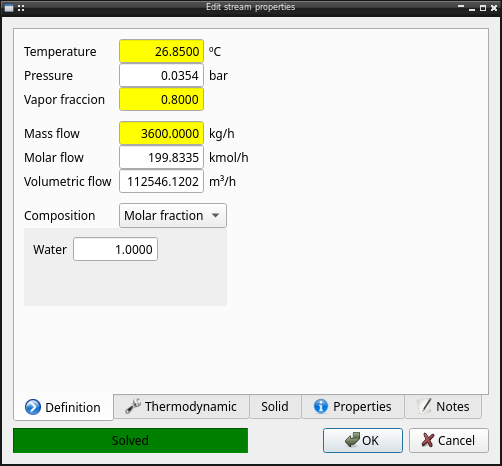
The specified properties are resalted in special color, to let user know the input parameters.
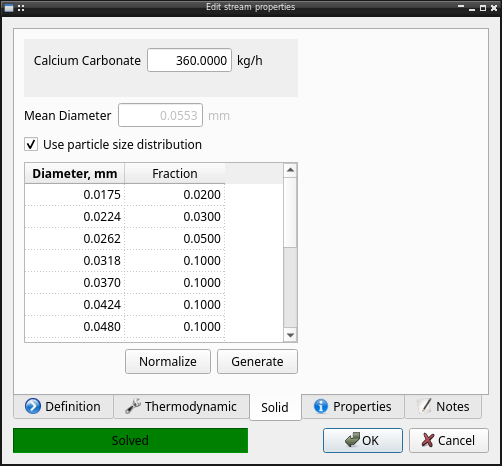
In case any solid compound is used the solid tab is enabled to configure solid properties
Its possible add any type of information in the notes tab with a basic text editor
Configuration
The methods used for calculation can be configurated in the Thermodynamic tab
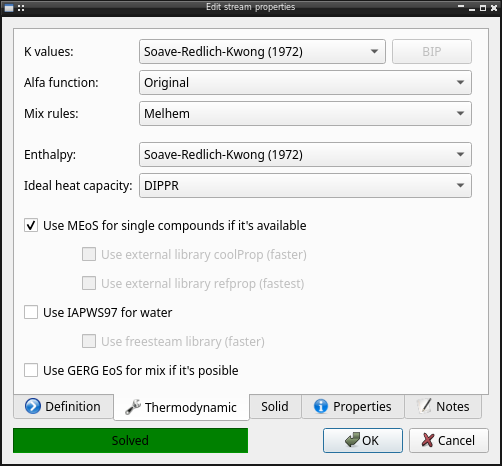
K values Configure the equation of state used for phase equilibrium calculation, including the binary interation parameters if the stream is multicomponent for the EoS with support for that. For several cubic equation is possible configure too the alpha function used, and the mixing rules for multicomponent stream.
H values Configure the methods (equation of state or other method) used for enthalpy calculation and the ideal enthalpy method.
Advanced options Furthermore it’s possible check any advanced option available like mEoS library, external library alternative to mEoS like coolProp or refProp if available, iapws for water, external freesteam library for water, mEos GERG extension to mixtures.
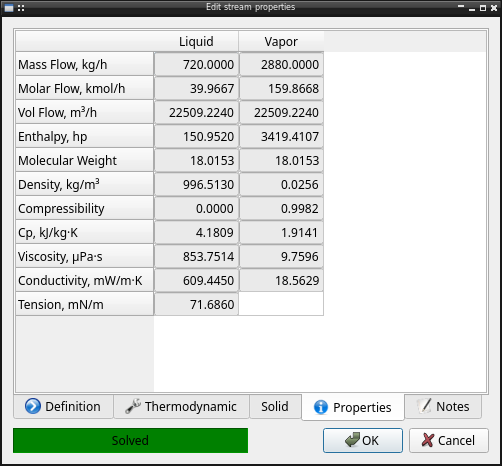
Properties
When the definition is complete the calculated properties can be see in the properties tab
API reference
Module with UI utilities
Ui_corriente: Widget for general stream input
Corriente_Dialog: QDialog for stream input
StreamDefinition: Stream definition with P,T,x,composition input
PsychroDefinition: Stream definition as humid air input
StreamProperties: Table for show stream properties
SolidDefinition: Solid particle stream definition
SolidDistribution: Dialog for define particle solid distribution
The module with library is in lib.corriente.html
- class UI.UI_corriente.Ui_corriente(corriente=None, readOnly=False, psychro=False, parent=None)[source]
Bases:
QWidgetWdiget for global stream edit/view
Methods
repaint(repaint repaint repaint)salida(**kwargs)Función que crea la instancia corriente
Changed
calculo
changePsychroState
changeSolid
clear
corriente
setCorriente
setReadOnly
- Changed
pyqtSignal(*types, name: str = …, revision: int = …, arguments: Sequence = …) -> PYQT_SIGNAL
types is normally a sequence of individual types. Each type is either a type object or a string that is the name of a C++ type. Alternatively each type could itself be a sequence of types each describing a different overloaded signal. name is the optional C++ name of the signal. If it is not specified then the name of the class attribute that is bound to the signal is used. revision is the optional revision of the signal that is exported to QML. If it is not specified then 0 is used. arguments is the optional sequence of the names of the signal’s arguments.
- __init__(corriente=None, readOnly=False, psychro=False, parent=None)[source]
corriente: Corriente instance to initialize widget readOnly: Set initial readOnly state for widget psychro: boolean to show aditional input stream por humid air
- corriente = <class 'lib.corriente.Corriente'> empty
- class UI.UI_corriente.Corriente_Dialog(corriente=None, readOnly=False, psychro=False, parent=None)[source]
Bases:
QDialog,Ui_corrienteDialog to define stream with status added
Methods
Changed
corriente
- Changed
pyqtSignal(*types, name: str = …, revision: int = …, arguments: Sequence = …) -> PYQT_SIGNAL
types is normally a sequence of individual types. Each type is either a type object or a string that is the name of a C++ type. Alternatively each type could itself be a sequence of types each describing a different overloaded signal. name is the optional C++ name of the signal. If it is not specified then the name of the class attribute that is bound to the signal is used. revision is the optional revision of the signal that is exported to QML. If it is not specified then 0 is used. arguments is the optional sequence of the names of the signal’s arguments.
- corriente = <class 'lib.corriente.Corriente'> empty
- class UI.UI_corriente.StreamDefinition(stream=None, readOnly=False, parent=None)[source]
Bases:
QWidgetWidget for stream definition as standard P,T,x composition input
Methods
calculo
changeFraction
changedFraction
changedValue
composicionEntrada
kwargs
setReadOnly
setResaltado
setStream
tipoFraccionesCambiado
- changedValue
pyqtSignal(*types, name: str = …, revision: int = …, arguments: Sequence = …) -> PYQT_SIGNAL
types is normally a sequence of individual types. Each type is either a type object or a string that is the name of a C++ type. Alternatively each type could itself be a sequence of types each describing a different overloaded signal. name is the optional C++ name of the signal. If it is not specified then the name of the class attribute that is bound to the signal is used. revision is the optional revision of the signal that is exported to QML. If it is not specified then 0 is used. arguments is the optional sequence of the names of the signal’s arguments.
- changedFraction
pyqtSignal(*types, name: str = …, revision: int = …, arguments: Sequence = …) -> PYQT_SIGNAL
types is normally a sequence of individual types. Each type is either a type object or a string that is the name of a C++ type. Alternatively each type could itself be a sequence of types each describing a different overloaded signal. name is the optional C++ name of the signal. If it is not specified then the name of the class attribute that is bound to the signal is used. revision is the optional revision of the signal that is exported to QML. If it is not specified then 0 is used. arguments is the optional sequence of the names of the signal’s arguments.
- class UI.UI_corriente.PsychroDefinition(psystream=None, readOnly=False, parent=None)[source]
Bases:
QWidgetWidget for stream definition as humid air input
Methods
Changed
calculo
rellenar
rellenarFlow
setReadOnly
setStream
stream
updatekwargsFlow
- Changed
pyqtSignal(*types, name: str = …, revision: int = …, arguments: Sequence = …) -> PYQT_SIGNAL
types is normally a sequence of individual types. Each type is either a type object or a string that is the name of a C++ type. Alternatively each type could itself be a sequence of types each describing a different overloaded signal. name is the optional C++ name of the signal. If it is not specified then the name of the class attribute that is bound to the signal is used. revision is the optional revision of the signal that is exported to QML. If it is not specified then 0 is used. arguments is the optional sequence of the names of the signal’s arguments.
- parameters = ['tdb', 'twb', 'tdp', 'w', 'mu', 'HR', 'v', 'h', 'Pv', 'Xa', 'Xw']
- stream = <lib.corriente.PsyStream object>
- class UI.UI_corriente.StreamProperties(stream=None, parent=None)[source]
Bases:
QTableWidgetTable to show stream properties
Methods
fill
- class UI.UI_corriente.SolidDefinition(solid=None, readOnly=False, parent=None)[source]
Bases:
QWidgetWidget for solids edit/view
Methods
Changed
botonGenerar_clicked
botonNormalizar_clicked
calculo
caudalSolido
caudalesSolidoFinished
checkDistributionToggled
distribucionFinished
fill
setReadOnly
setSolido
solido
- Changed
pyqtSignal(*types, name: str = …, revision: int = …, arguments: Sequence = …) -> PYQT_SIGNAL
types is normally a sequence of individual types. Each type is either a type object or a string that is the name of a C++ type. Alternatively each type could itself be a sequence of types each describing a different overloaded signal. name is the optional C++ name of the signal. If it is not specified then the name of the class attribute that is bound to the signal is used. revision is the optional revision of the signal that is exported to QML. If it is not specified then 0 is used. arguments is the optional sequence of the names of the signal’s arguments.
- solido = <class 'lib.solids.Solid'> empty
- class UI.UI_corriente.SolidDistribution(parent=None)[source]
Bases:
QDialogDialog to specified parameter to model particle solid distribution Teoretical model implemented:
Rosin, Rammler, Sperling (Weibull distribution) Gates, Gaudin, Shumann Gaudin, Meloy Broadbent, Callcott Distribución lognormal Harris
- Generate distribution to several standard test sieves:
Tyler ASTM E 11-70 DIN 4188 AFNOR NFX11-501 ISO 565 BS 410
Methods
aceptar
standardCambiado
- Sieve = {'AFNOR': [0.02, 0.022, 0.025, 0.028, 0.032, 0.036, 0.04, 0.045, 0.05, 0.056, 0.063, 0.071, 0.08, 0.09, 0.1, 0.125, 0.14, 0.16, 0.18, 0.2, 0.224, 0.25, 0.28, 0.315, 0.355, 0.4, 0.45, 0.5, 0.56, 0.63, 0.71, 0.8, 0.9, 1.0, 1.18, 1.25, 1.4, 1.6, 1.8, 2.0, 2.24, 2.5, 3.15, 3.55, 4.0, 4.5, 5.0, 5.6], 'ASTM': [0.02, 0.025, 0.032, 0.038, 0.045, 0.053, 0.063, 0.075, 0.09, 0.106, 0.125, 0.15, 0.18, 0.212, 0.25, 0.3, 0.355, 0.425, 0.5, 0.6, 0.71, 0.85, 1.0, 1.18, 1.4, 1.7, 2.0, 2.36, 2.8, 3.35, 4.0, 4.75, 5.6, 6.3, 6.7, 8.0, 9.5, 11.2, 12.5, 13.2, 16.0, 19.0, 22.4, 25.0, 26.5, 31.5, 37.5, 45.0, 50.0, 53.0, 63.0, 75.0, 90.0, 100.0, 106.0, 125], 'BS': [0.045, 0.053, 0.063, 0.075, 0.09, 0.106, 0.125, 0.15, 0.18, 0.212, 0.25, 0.3, 0.355, 0.425, 0.5, 0.6, 0.71, 0.85, 1.0, 1.18, 1.4, 1.7, 2.0, 2.36, 2.8, 3.35, 4.0, 4.75, 5.6], 'DIN': [0.02, 0.022, 0.025, 0.028, 0.032, 0.036, 0.04, 0.045, 0.05, 0.056, 0.063, 0.071, 0.08, 0.09, 0.1, 0.125, 0.14, 0.18, 0.2, 0.224, 0.25, 0.28, 0.315, 0.355, 0.4, 0.5, 0.56, 0.63, 0.71, 0.8, 0.9, 1.0, 1.18, 1.25, 1.4, 1.6, 1.8, 2.0, 2.24, 2.5, 2.8, 3.15, 3.55, 4.0, 4.5, 5.0, 5.6], 'ISO': [0.02, 0.022, 0.025, 0.028, 0.032, 0.036, 0.045, 0.05, 0.063, 0.071, 0.08, 0.09, 0.1, 0.125, 0.14, 0.18, 0.2, 0.224, 0.25, 0.28, 0.315, 0.355, 0.4, 0.45, 0.63, 0.71, 0.8, 0.9, 1.0, 1.18, 1.25, 1.4, 1.6, 1.8, 2, 2.24, 2.5, 2.8, 3.15, 3.55, 4, 4.5, 5, 5.6], 'Tyler': [0.033, 0.043, 0.053, 0.061, 0.074, 0.088, 0.104, 0.121, 0.147, 0.173, 0.208, 0.246, 0.295, 0.351, 0.417, 0.495, 0.589, 0.701, 0.833, 0.991, 1.168, 1.397, 1.651, 1.981, 2.362, 2.794, 3.327, 3.962, 4.699, 5.613, 6.68, 7.925]}
- model = {'Broadbent Callcott': {'magnitud': ['ParticleDiameter', ''], 'title': ['d*=', 'N='], 'unit': [<class 'lib.unidades.Length'>, <class 'float'>]}, 'Gates Gaudin Schumann': {'magnitud': ['ParticleDiameter', ''], 'title': ['d*=', 'N='], 'unit': [<class 'lib.unidades.Length'>, <class 'float'>]}, 'Gaudin Meloy': {'magnitud': ['ParticleDiameter', ''], 'title': ['d*=', 'N='], 'unit': [<class 'lib.unidades.Length'>, <class 'float'>]}, 'Harris': {'magnitud': ['ParticleDiameter', '', ''], 'title': ['d*=', 'S=', 'N='], 'unit': [<class 'lib.unidades.Length'>, <class 'float'>, <class 'float'>]}, 'Lognormal': {'magnitud': ['ParticleDiameter', ''], 'title': ['d*=', 'σ='], 'unit': [<class 'lib.unidades.Length'>, <class 'float'>]}, 'Rosin Rammler Sperling': {'magnitud': ['ParticleDiameter', ''], 'title': ['d*=', 'S='], 'unit': [<class 'lib.unidades.Length'>, <class 'float'>]}}
